- -14%

onsale

In Stock

In Stock

In Stock


In Stock

Available upon request

In Stock
Out of Stock
Out of Stock
Out of Stock
Out of Stock
Out of Stock
Out of Stock
Out of Stock
Out of Stock

Featured Products
Out of Stock
Out of Stock
Out of Stock
Out of Stock
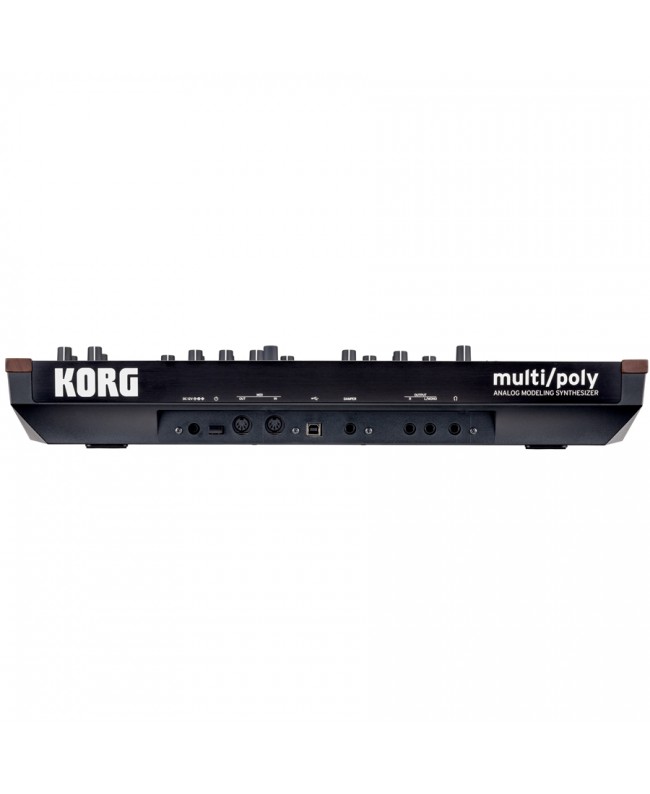

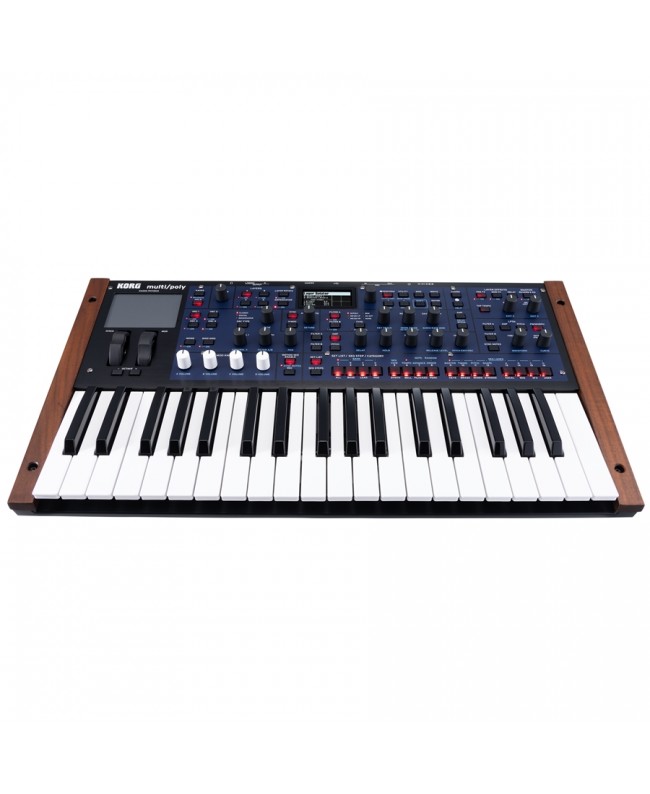
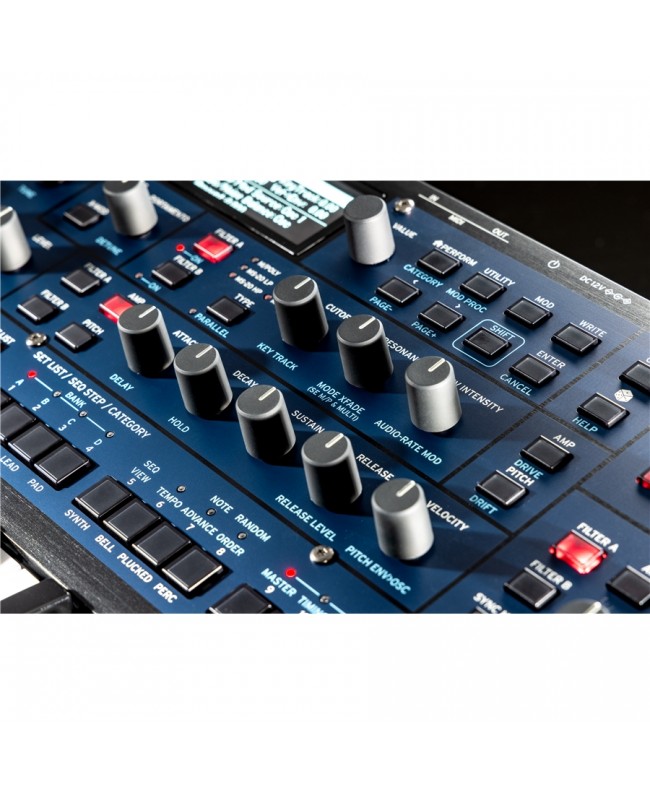
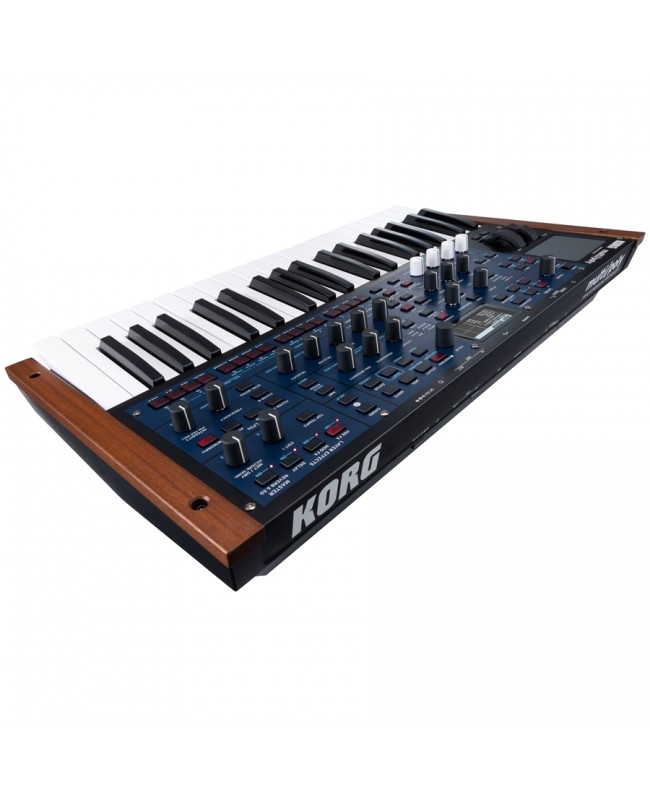
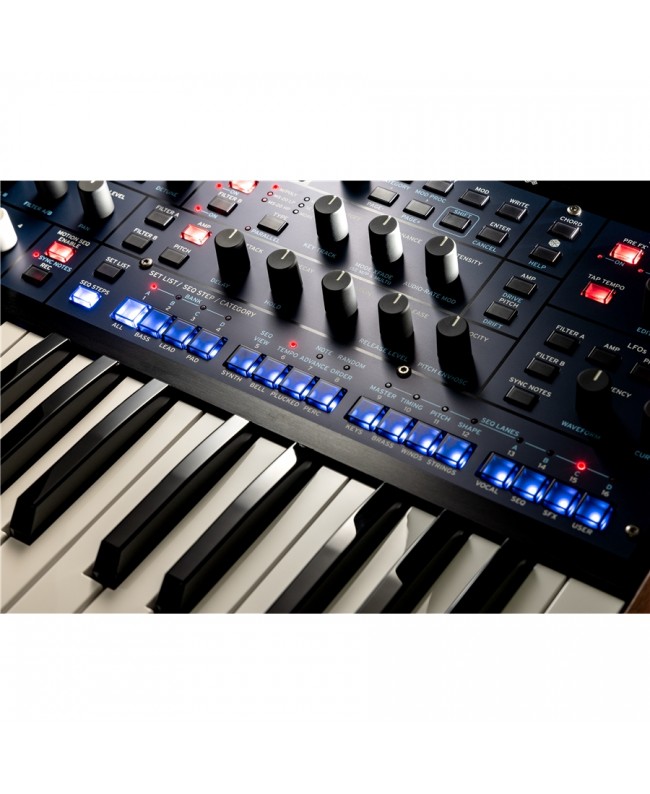
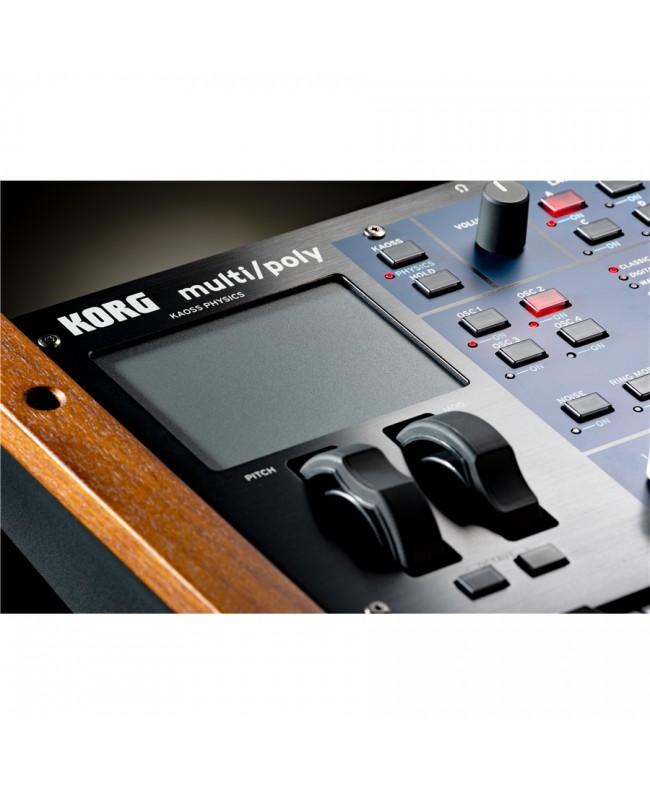
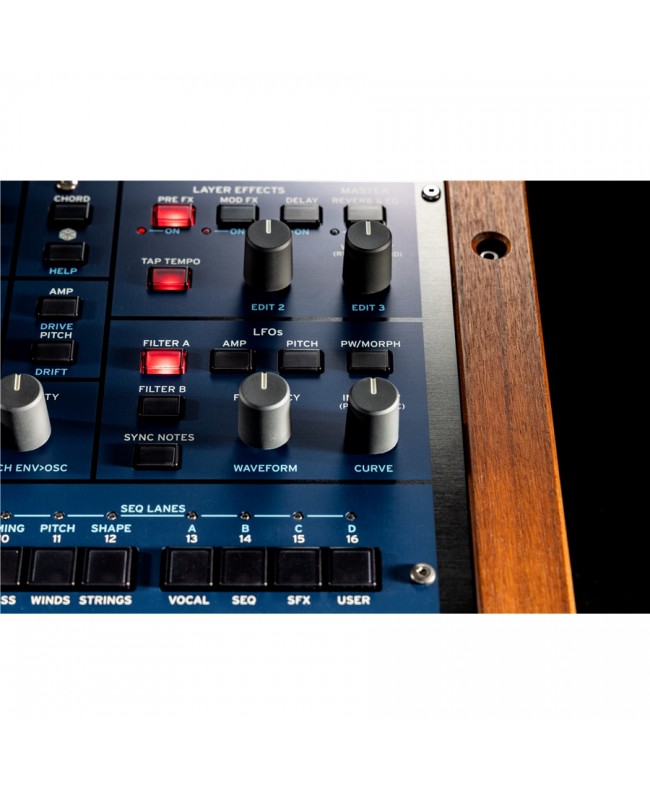
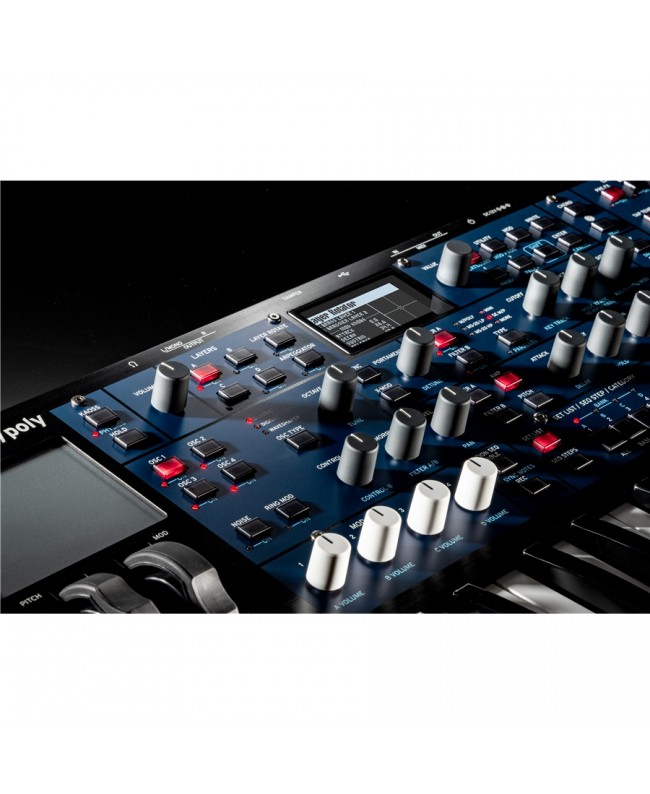

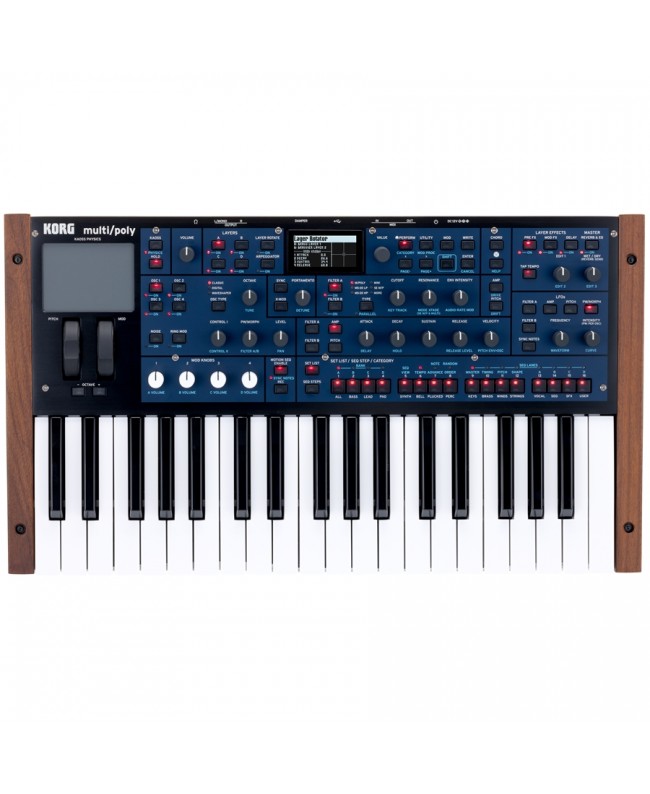
KORG multi/poly is a next-generation analog physical modeling digital synth inspired by KORG's classic vintage Mono/Poly, which combined at the time thick timbres and experimental functions typical of modular synthesizers. Using modern digital multi/poly technology, it produces extremely realistic analog timbres, combining computational power, high polyphony and versatility of use, with an articulate Program-based synthesis structure with 4 oscillators, noise, two filters, envelopes, modulations, and Insert effects each. In turn 4 Programs can be included in a Performance with Motion Sequence 2.0 and Kaoss Physics functions that add additional movement and timbral complexity.
Inspired by the legendary KORG Mono/Poly, the new KORG multi/poly analog physical model synthesizer offers impressive analog sounds combined with the power and versatility flexibility of the digital generation. The original Mono/Poly boasted an extremely rich sound from its four stacked oscillators, as well as unique and experimental features such as versatile x-mod and sync routing and round-robin oscillator triggering. Previously obtainable only in large modular systems, the Mono/Poly offered these features in a compact and easy-to-use instrument.
The new Multi/Poly is the first instrument to use KORG's next-generation analog modeling technology and is based on the combination of great effectiveness and functions derived from modular synths, such as having a polyphonic modular system in a compact, easy-to-use instrument that is ideal for musicians and sound designers. You can create combinations of East-coast, West-coast and wavetable oscillators with newly developed filters, modulated by envelopes, VCAs and portamento. While virtual vocal cards produce natural timbral variations, with the Layer rotation function activating new Programs with each key press, and in addition: Kaoss Physics, Motion Sequencing 2.0, effective modulations further animate each sound making it more interesting.
The multi/poly is equipped with newly developed and extremely effective sounding filters and oscillators. In fact, each voice has a Virtual Voice Card whose oscillators, filters, envelopes, LFOs and portamento circuits faithfully reproduce the variations of analog hardware components. The result is that each voice turns out to have a slightly different character, producing rich and natural timbres. This variation is independently adjustable for each sound as desired. As in an analog synthesizer, the Virtual Voice Cards continue to play even if they are not heard, as do the envelopes. Thus by playing, for example, a Pad with a long release time, the notes just played will hook the envelope to the current level instead of restarting from zero. In the same way the oscillators and LFOs maintain their phase and the resonance also continues to play. The pitch of each oscillator can also drift slightly over time, reproducing the slight pitch instabilities as in analog hardware.
Envelopes are an often overlooked element that contributes to the unique sounds of vintage synthesizers. The multi/poly includes presets in the envelope curves of: Mono/Poly, MS-20, Mini, Pro, ARP Odyssey, and others. In addition, analog VCAs do not respond uniformly to voltage and have different thresholds for turning on and off, which in turn has a strong effect on the character of the Amp Envelope. Therefore, the multi/poly presents VCA responses shaped by the: Mono/Poly, MS-20, Mini, Odyssey and Prophet 5, as well as a linear option for the Amp Envelope. Have you ever tried to recreate the Portamento effect of a favorite song, but couldn't find the right setting even when switching from constant rate to constant time? Even classic analog synthesizers had different approaches to Portamento, so multi/poly offers six different portamento patterns to choose from.
Multi/poly has FOUR oscillators for each Program, this allows for dense and complex timbres. Each oscillator can use the modes: Classic, Digital or Waveshaper. Classic reproduces traditional analog synth oscillators with great fidelity, with a choice of 11 options including single and dual waveforms, to emulate those synthesizers that generated multiple waveforms simultaneously. Front-panel knobs provide convenient control over pulse width (Pulse Width), triangle lean, mixing of dual waveforms, and more.
The Digital-type oscillator produces wavetables with up to 64 Steps, like Vintage hybrid synthesizers and modern Eurorack modules. There are over 200 factory wavetables, and you can load your own using the Editor/Librarian software for macOS and Windows. You can Import modwave wavetables directly or those converted from popular software. Over 30 Modifiers can change the way the tables are loaded, resulting in many timbral nuances from the most delicate and subtle to the most extreme, while 8 types of Morph such as: Stretch, Flip and Mirror process them in real time.
Waveshaper offers a West-Coast approach, in which simple waveforms (sine or triangle) are processed through a Shaper table. Gain modulation in the shaper creates crystalline and dynamic harmonics. You can use the Berkeley Shaper for traditional wavefolder timbres or choose from over 90 other Shaper types. The multi/poly also allows you to modulate the Pulse Width (square wave pulse width) to add an extra dimension of richness and movement. An independent noise generator is also available for each oscillator.
All filters in the multi/poly are newly designed, and include a suite of vintage filters with euphonic saturation. Five different models are available with 4-pole Auto-Resonance, with the classic Korg Mono/Poly tone. Mini is the Ladder filter of the renowned American monophonic synth; resonance is reduced at low frequencies an essential feature for producing typical bass sounds. Pro is modeled from the first programmable polyphonic synth, with resonant and obvious sweeps over the entire range. Finally, Ladder HP and BP are 4-pole self-resonant high-pass and band-pass filters, respectively.
The MS-20 LP and HP 12dB/octave self-resonant Korg 35 filters reproduce the aggressive tonal characteristic of the classic Korg MS-20, while 2-pole SE M/P filter has a more delicate character and features a continuous control that allows you to switch between low-pass and band-pass and high-pass, as well as a separate mode for band-pass. You can also shape and each sound with a full set of linear and resonant 2- and 4-pole low-pass, high-pass, band-pass and band-pass filters. Or, stepping outside the box use KORG's exclusive Multi Filter, which creates a modulable mix of multiple filters at once.
All filters are also modulatable, allowing for distinctive and dynamic timbres. You can also use any oscillator, or the Ring Modulator as modulation sources and also add the Noise Generator to achieve chaotic sounds. Finally, it is possible to use any two filters simultaneously, in series or in parallel. The Programs have two Slots for the filters, A and B. Each source, including the four oscillators, Noise and Ring Mod, has a balance control that switches between filters, allowing a wide range of creative options. For example, you can send one group of oscillators through the M/Poly filter and the other through the MS-20's low-pass filter. Create a classic serial high-pass-low-pass chain, but route one or more oscillators around the high-pass. Since this is a continuous cross-fade, and not just a switch, you can modulate the A/B balance for unique effects. The filters can also operate in stereo, with separate panning for each source.
Each Program includes four oscillators plus a noise generator, ring mod, sync and x-mod. These are processed through two independent filters and modulated with four DAHDSR envelopes, five LFOs and six Mod Processors. Added to this is Motion Sequencing 2.0 Multi-Lane and three studio-quality Insert effects. But this is just a single Program. Up to four Programs can be stacked to make up a performance. The transition between each Program is Round-Robin style with Layer Rotate (rotation between Programs), either playing from the keyboard or using the arpeggiator. The Kaoss module create additional smooth and evolving modulation with simple gestures on the X/Y Pad. The four Mod knobs on the panel offer intuitive and immediate control over various parameters. The finishing touch to each performance is provided by two other Mod processors, the Master Reverb, and the EQ.
The multi/poly has four Layers, each of which contains a Program. With these you can create Layer, Velocity and Keyboard Split sounds. The Layer Rotate is inspired by the paraphonic mode of the original Mono/Poly, which moved cyclically between the four oscillators, this function now adds a new possibility: the Round-Robin between all Programs. By setting each Layer with different Programs, it is possible to alternate between them each time the keys are pressed, playing them in cyclic or random order. Activate one, two or three Programs for each Step in the cycle, and you can use the Layer Rotate with the arpeggiator to get interesting Patterns.
multi/poly has a panel full of knobs and controls that invite exploration, Oscillators, filters, envelopes, LFOs and effects are all at your fingertips. The four programmable Mod knobs allow you to customize by assigning favorite parameters, the knobs can be used to modify each timbre in real time and save the result. The Hold button allows you to sustain notes or chords indefinitely while exploring the front panel controls or playing other instruments. If you add the Kaoss Physics and the Pitch Bend and Modulation wheels, you always have multiple expressive possibilities in real time. Finally, almost every knob on the front panel and most of the parameters on the screen can be modulated, for a total of more than 5,500 modulation destinations. It is even possible to modulate individual Steps of the Motion Sequence, eight Mod processors allow you to transform modulation signals using quantization, smoothing, warping, and more.
Motion Sequencing 2.0 is an evolution of wavestate's Wave Sequencing 2.0. Timing, Pitch, Shape and four sets of Step Sequence values are separated into Lanes, each with its own Loop start and end, and a deeper level in recording phrases and modulations. Each time the sequence advances, the individual Lanes are combined to create the output. For example, a Step Sequence value can correspond to a different duration, pitch and shape each time it is played. You can modulate the loop points in each Lane separately for each note, using velocity, LFOs, envelopes, Mod knobs or other Controllers, so each note in a chord can sound different. In the Lanes it is also possible to randomize the order of the Steps each time they are played. In the same way individual Steps can be skipped randomly, with a probability that can be modulated from 0 to 100%. The result is a natural, changeable and fully controllable sound.
Kaoss Physics reproduces a pattern of a ball rolling on a surface and bouncing off walls. The surface can tilt in any direction. A bump of varying height/depth and position attracts or repels the ball. Adjustable friction slows the ball's travel, and adjustable timing controls the speed of the entire pattern. All these features are adjustable and can be changed in real time. To start the ball, simply touch the x/y pad with a finger, or launch it automatically using another source of modulation. You can also control the ball directly by holding your finger on the pad. The position of the ball produces eight modulation signals, which can be used to control any modulation destination: the X and Y positions, the distance from the center, the angle with respect to the X axis, and finally separate signals for +/- X and +/- Y. The walls can slow the ball down, as if they were padded, or speed it up, like the bumpers on a pinball machine. The walls can also be removed completely, so that the surface wraps around to opposite edges, as in a vintage arcade game. The modeled environment can create specific modulation effects. For example, one can use a Bump centered with negative height, so that the modulation values always return to 0. Or one can place a Bump with positive height on one side or corner, to move the modulation values away from that area. The result is an interactive controller that amplifies your physical gestures, turning them into complex musical signals.
multi/poly offers a complete high-quality effects chain. Each Layer has three dedicated effects, plus a send to the performance master reverb, followed by a parametric master EQ. In addition to standard effects such as compressors, EQ, chorus, flanger, phaser and stereo delay, distinctive processors such as: Wave Shaper, Talking Modulator, Reverse Delay, Multiband Mod Delay, and Overb (from OASYS and Kronos), as well as effects modeled from VOX guitar amplifiers, VOX wah, Vintage Distortion, CX-3 Rotary Speaker and Vibrato/Chorus, tape echo, and a collection of classic guitar pedals.
The Editor/Librarian for multi/poly allows you to edit and organize sounds via computer (macOS or Windows). it uses the high-speed USB port for communication, and works as if it were a second front panel, so there is no need to sync or transfer data. Animations show modulation effects in real time-a great help for programming.
Set Lists and Smooth Sound Transitions
Set Lists allow the organization of multi/pole performances, with immediate access during concert or rehearsal. Smooth Sound Transitions allow notes and effects played to continue naturally even after a new sound is selected, without annoying interruptions.
Multi/poly is an instrument made with professional design and durable, high-quality materials. The keyboard is responsive and has a consistent touch, knobs and switches return a solid and right feel, the sturdy front panel is made of aluminum, and the wooden sides contribute to the overall look of the synth that echoes the color scheme of the original Mono/Poly.
Multi/poly has balanced stereo outputs to connect to any recording or monitoring system, while the stereo headphone output is ideal for private playing or stage monitoring. MIDI sockets (DIN type) ensure connection with other equipment equipped with this protocol, while USB supports MIDI Class-Compliant with Windows and macOS computers.
Data sheet
Specific References

On sale
Out of Stock
In Stock

In Stock
Out of Stock
bestseller
In Stock
In Stock
In Stock
In Stock
Available upon request
In Stock