
- -2%
- New

onsale

In Stock

In Stock

Out of Stock


In Stock


Available upon request

In Stock

Out of Stock

Out of Stock

Available upon request

Out of Stock
Out of Stock

In Stock

In Stock

Download

Featured Products

Out of Stock

In Stock

In Stock

Out of Stock
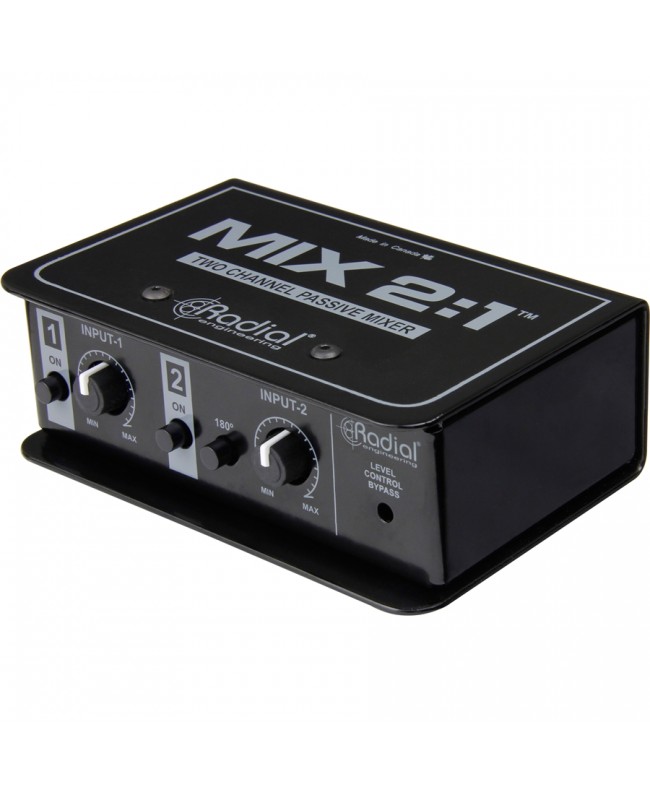
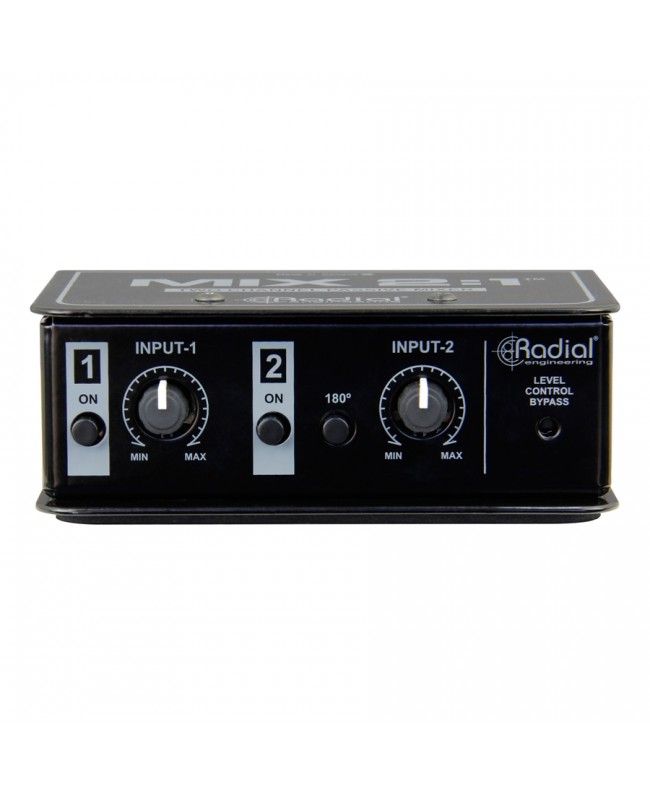
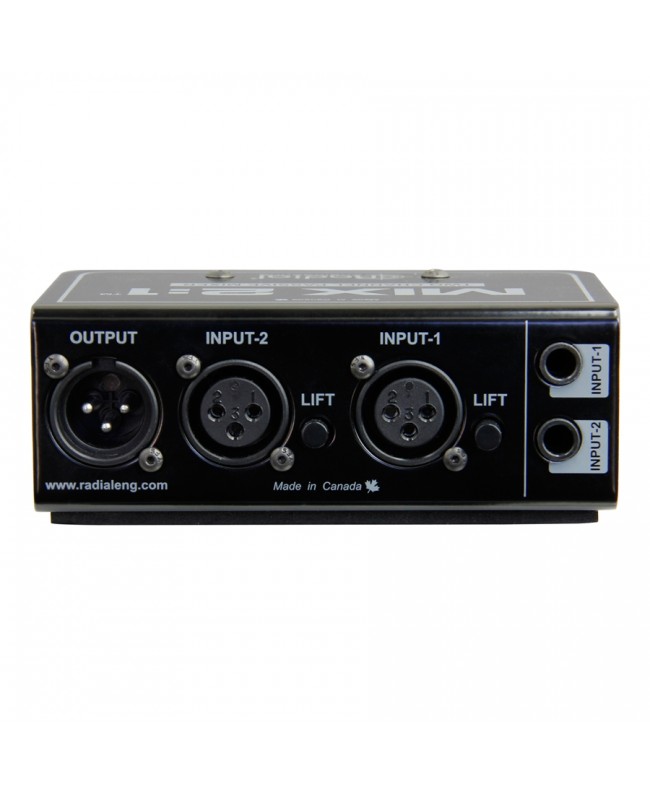
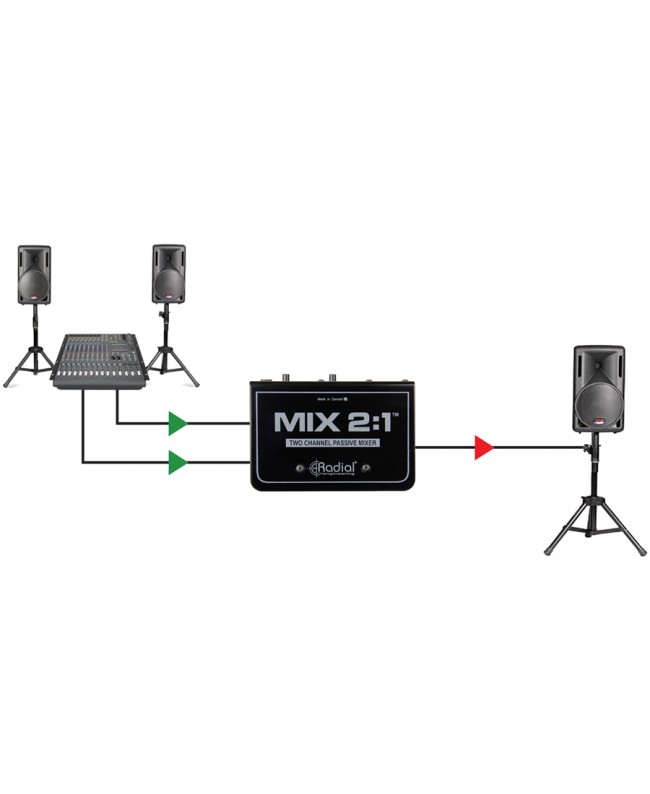
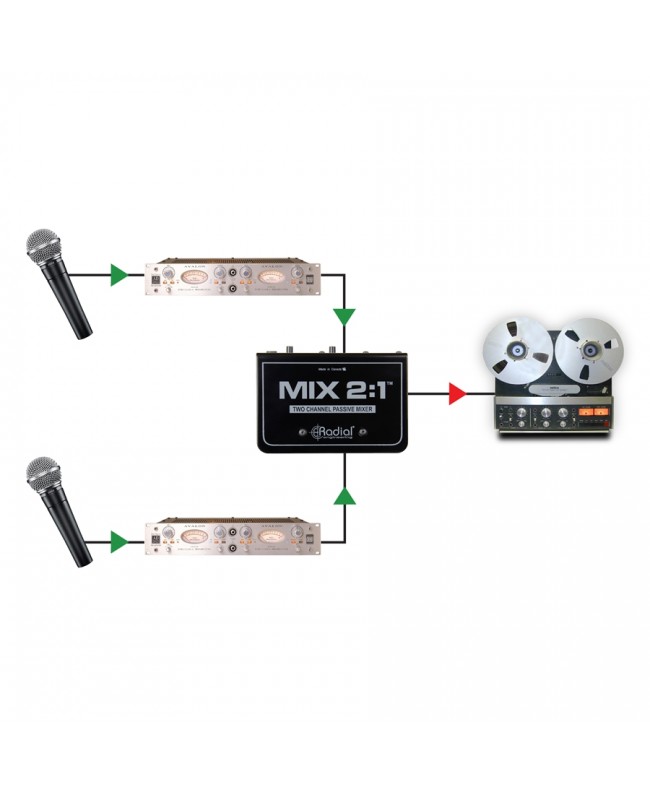
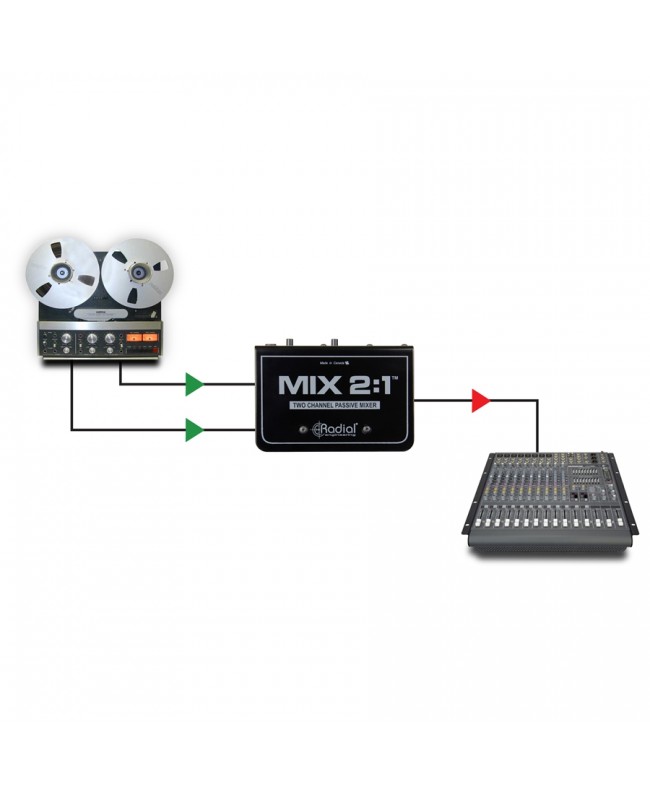
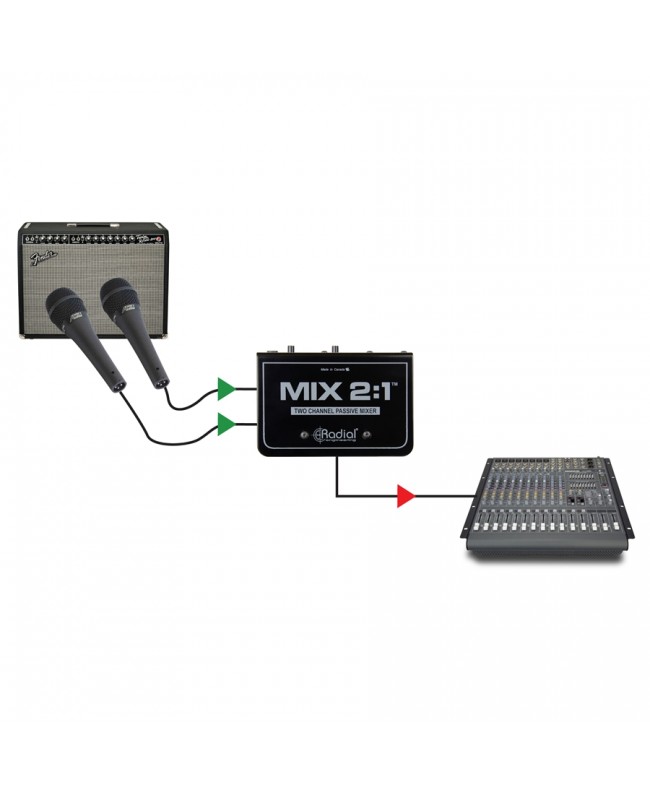

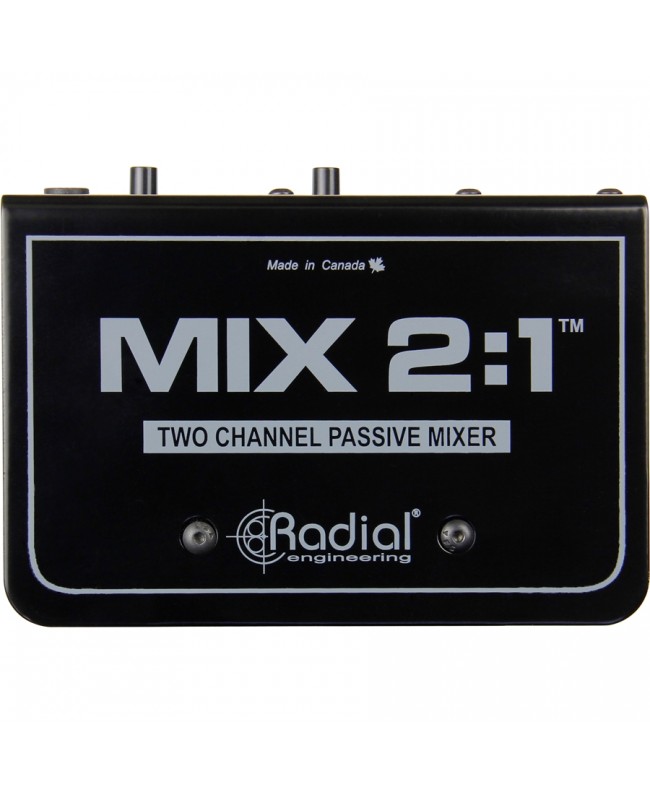
Radial Engineering's MIX 2:1 Audio Combiner is a 2-Channel Mixer that passively sums two audio channels into one. This allows you to send stereo signals from a Mixer, sound card, mono portable playback device, or Mix two signals together and balance their input levels on a single output.
MIX 2:1's inputs have XLR and ¼ TRS connectors, with ground-lift (grounding) switches that eliminate noise and hum from ground loops ensuring noise-free operation. You can turn each input on and off individually to hear signals before summing them. There is a Trim control for each input: by connecting two separate mono sources such as the outputs of two mic preamps, you can attenuate them as needed by matching their levels to the output. Both level controls can be completely bypassed, summing inputs 1 and 2 with the same settings, and preventing accidental or unwanted level changes. MIX 2:1 has a 180° switch on Input-2, to solve frequency cancellation problems due to out-of-phase inputs. Both signals are passively summed, then sent a single XLR output that can be connected to an active speaker, or to the input of a console or recording interface. The MIX 2:1 is made of rugged 14-gauge steel, and features the classic I-beam design that prevents stress on the circuit board by preserving it from solder failures, as well as a book-like design that protects the level controls and switches. A military-spec printed circuit board and high-quality components help maintain the integrity of audio quality, without distortion or phase shifting, to have fully transparent passively summed signals.
Activate the level control bypass to sum both channels to unity gain in the mono input of a speaker or recording device.
Combine two tracks into a single input on your audio interface. Use 180° phase inversion to ensure phase consistency between the two inputs.
When available channels are in short supply, MIX 2:1 allows you to sum a stereo output to mono, using a single channel on the console.
MIX 2:1 also works with microphone-level signals, which is useful when available input channels are low or you want to process two microphones using the same signal chain.
MIX 2:1 is a simple summing mixer that makes it easy to combine two audio signals. Whether you need to sum microphone or line signals, or the outputs of two separate devices, MIX 2:1 allows you to do so without noise or sound coloration. XLR and ¼ TRS inputs are provided for easy connectivity, with a single XLR output to power the target device. Level controls are provided for each input, which can be bypassed completely by summing the left and right outputs of a mixing console or recording interface. A 180-degree polarity reversal switch, for example, allows you to sum the signal from a microphone located on the top of the snare drum and the signal from a microphone located on the bottom and send it to a single preamplifier, while ground-lift switches eliminate noise and hum caused by ground loops. Before making connections, make sure your sound system is turned off and all volume levels are turned down to prevent connection transients from damaging your speakers or other sensitive components. MIX 2:1 is passive and requires no power supply. Each input has a ¼ TRS connector and an XLR connector to accept balanced Mic-level or Line-level signals. For best results, use only one of these types of connectors at a time on each channel. The XLR output of MIX 2:1 may be Mic-level or Line-level depending on the input sources and the amount of attenuation applied using the input Trim controls. Keep in mind that MIX 2:1 does not provide any gain to the input signal, so if you connect two microphones to the inputs you will still need a mic preamp to boost the signal to line-level.
With MIX 2:1, you can take a stereo signal from a mixing console or recording interface and quickly sum it into a mono signal to feed a single speaker input on a PA system. Press the ON buttons for both inputs to activate them. Then activate the recessed switch on the right side of MIX 2:1 LEVEL CONTROL BYPASS-this will disable the input level controls for each channel to ensure equal summing. MIX 2:1 will automatically compensate for the 6dB voltage gain that occurs when two in-phase signals are summed together, so as not to distort the inputs of the target device. To attenuate levels, simply turn LEVEL CONTROL BYPASS off and adjust each level control until the desired results are achieved.
MIX 2:1 is also useful for summing audio signals from two different devices, such as a guitar microphone and a passive DI, or microphones placed above and below a snare drum. When summing two separate sources, start with the input level controls fully clockwise (to maximum) and use the ON switches to listen to each channel individually. If one signal is significantly louder than the other, use the level control for that channel to achieve the desired balance between the two signals.
MIX 2:1 includes a 180° switch that flips the polarity of the audio on INPUT-2-sometimes called phase inversion. When two audio signals have similar contents but have reversed polarity, by adding the signals together certain frequencies can be cancelled or amplified, creating a filtered or unnatural sound result. The 180° switch can be a quick way to reverse this effect and bring the signals back into alignment with each other, resulting in a fuller, more balanced sound.
When connecting two or more powered devices, noise and hum caused by ground loops may occur. MIX 2:1 has Ground-lift switches on both inputs that disconnect pin-1 on the input connectors, interrupting the electrical path to ground and removing the noise. If you experience noise or hum when using MIX 2:1, simply use these switches to eliminate the problem.
Specific References

On sale

In Stock
Out of Stock

Out of Stock
bestseller
In Stock
In Stock
Out of Stock

In Stock


Available upon request

In Stock