- New

onsale

In Stock

In Stock

Out of Stock


In Stock

Available upon request

In Stock
Out of Stock
Out of Stock

Available upon request

Out of Stock
Out of Stock
In Stock

In Stock
Download

Featured Products

Out of Stock
In Stock

In Stock
Out of Stock
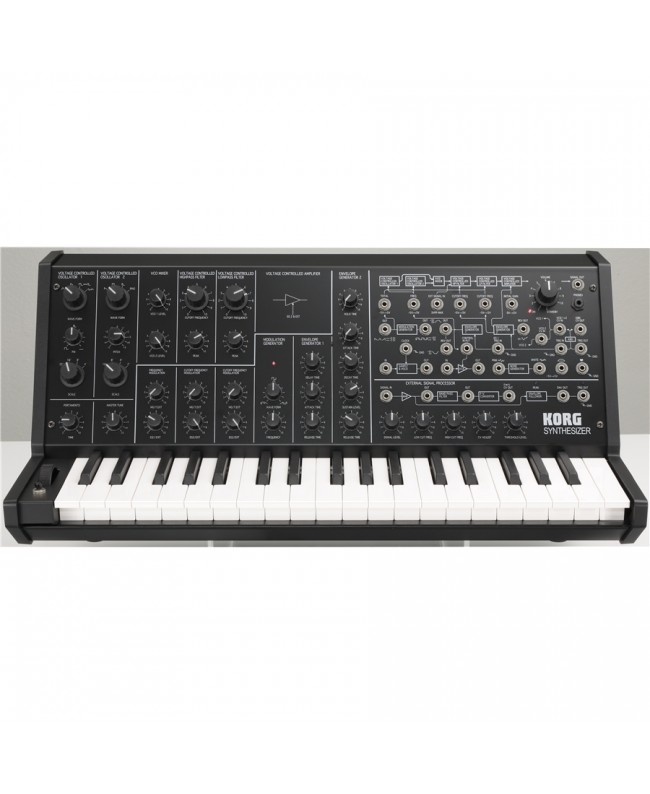
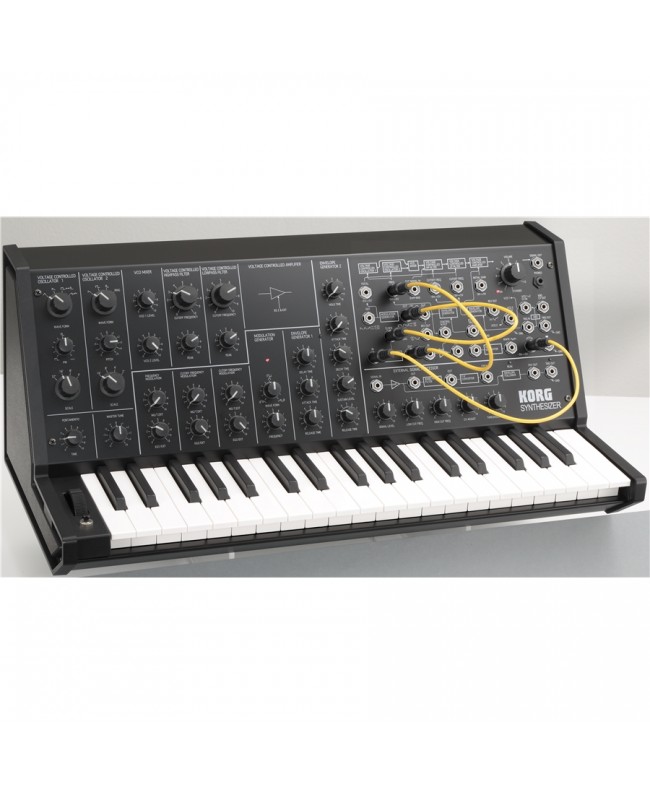
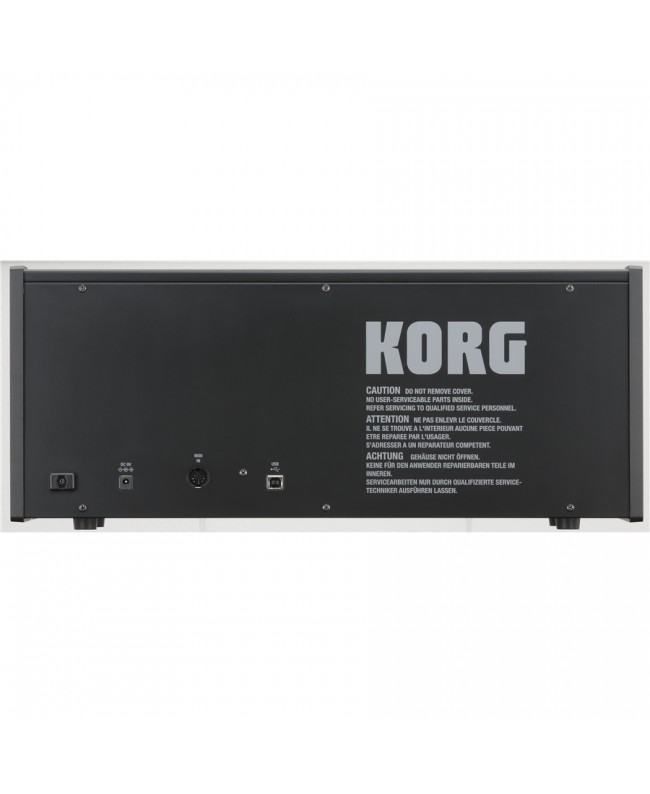
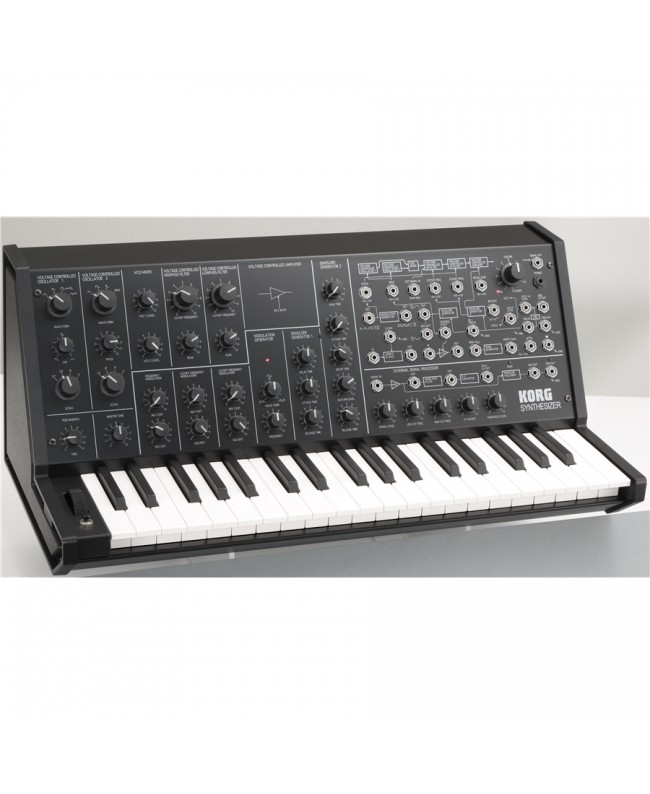
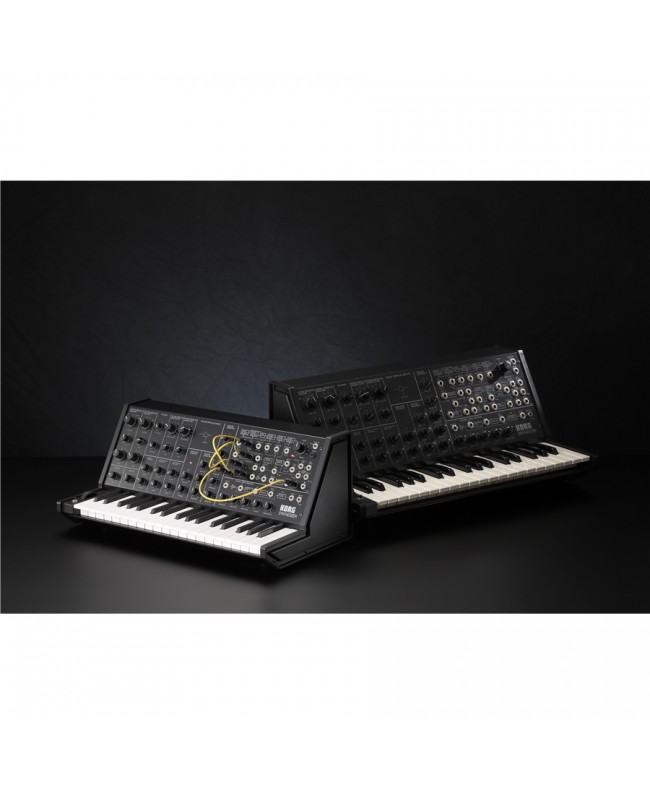

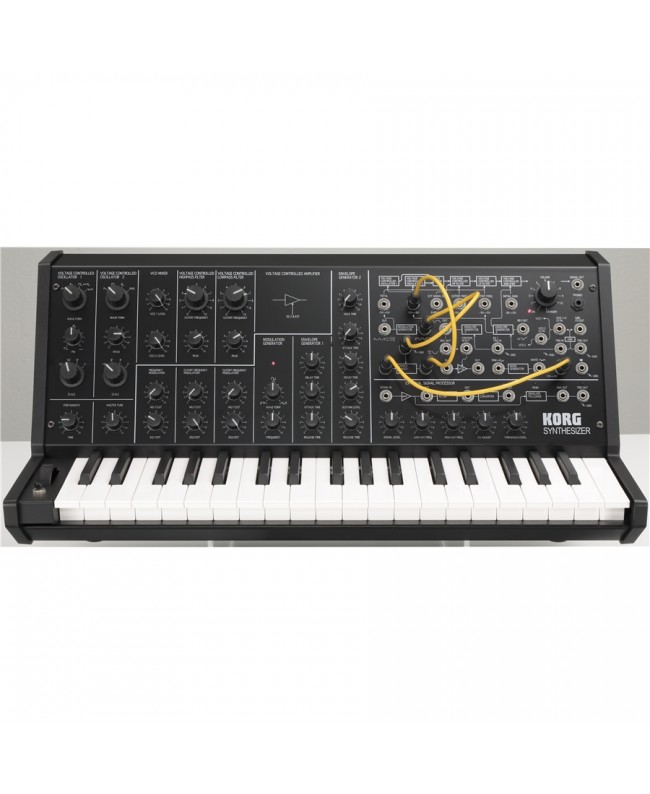
Korg reintroduces the analog synthesis of the MS-20 in a compact format: same circuit, same filter, truly analog, with the addition of MIDI In and USB.
For those looking for a true analog synthesizer, the Korg MS-20 mini represents the essence of semi-modular sound synthesis in a compact format that can be conveniently placed on our desks or consoles. A perfect instrument for those who, in addition to the typical analog sound, want to delve into the world of modular synthesis, thanks to a special section that allows the user to modify by patching the interconnection between circuit modules. A must-have tool in educational settings where sound synthesis is studied.
The KorgMS-20 mini is a perfect replica of the MS-20. The design team was captained by the same engineers who produced the original model in 1978, with the aim of recreating the same circuitry. The synthesis structure is the same distinctive as the original instrument. MS-20 mini features two oscillators with ring modulation, envelope generators, hold and delay. The VCA has been optimized so that it generates less noise than the original model, but without varying its basic structure. One of the most important distinguishing features of the MS-20 was the powerful resonant high-pass and low-pass filters. Maximizing the resonance was to create a self-oscillation of the filter, which constituted a real peculiarity, a drastic change in the sound defined by many as ''inimitable.'' The same system also adopted in the other analog synths currently part of the Korg catalog: monotron and monotribe. In the middle of its production cycle, MS-20 changed the filter circuit: the MS-20 mini implements the first filter adopted in the original model, judged by many to be the best, because of its characteristic intervention. At the time, another strength of Korg's homegrown monophonic analog synthesizer was the input for processing external signals (ESP). This allowed-and allows in the new mini model-to use pitch and volume of an external audio source to control the synthesis engine. Thanks to the patchbay built into the right side of the panel, it is possible to link the various modules together in order to create more complex sounds. The sonic possibilities are confined to the user's imagination, as different combinations of modulation in/out triggers, sample and hold, and noise generator can give rise to an invaluable variety of sounds. Thanks to the screen-printing on the patchbay panel, these operations will be simply doable even by novice users.
The MS-20 mini has a traditional DIN format MIDI input and a USB MIDI port for transmitting and receiving notes only (no velocity, no controller). You can then play the mini-MS-20 using other MIDI keyboards, or from your computer. At the same time, you can play software instruments installed on your computer with the instrument's keyboard. Efforts to achieve a strict reproduction of the original were not limited to the product alone. Even the box reproduces that of the time to perfection, including the original product manual with relevant setting directions.
Introduced to the market in 1978, the Korg MS-20 monophonic synthesizer is still one of the most sought-after and appreciated analog synths today, thanks to its full-bodied and powerful sound, its iconic analog filter, and the extreme versatility offered by its patching options. Nearly 400,000 people have enjoyed and used the distinctive sound of the MS-20, in its original version, in the virtual version available for both PC and MAC computers and as an iPad app (iMS-20). Designed by the same engineers who took part in the development of the original MS-20, this new version uses the same circuitry and attractive look, while reducing the size of the instrument by about a 14 percent. MS-20 mini brings the authentic analog sound back into the hands of today's musicians, DJs and producers.
Fifty years have passed since the founding of Korg, and we have returned to putting our hands on an analog synthesizer. We paid special attention to providing precise and continuous parameter control as required by analog synthesis. The same we devoted to reproducing the original specifications of the MS-20. The analog circuitry we designed 35 years ago continues to generate an inimitable sound, powerful across the entire frequency range from ultra-low to high frequencies. We invite you to try this instrument yourself to appreciate this sound experience firsthand.
The Korg MS20 mini is a perfect replica of the MS20. The design team was captained by the same engineers as the original model, with the aim of recreating the same circuitry, painstakingly evaluating, with meticulous comparisons, the use of any replacement components for those no longer available on the market today. The synthesis structure is the same. MS20mini has two oscillators with ring modulation, envelope generators, hold and delay. The VCA has been optimized so that it generates less noise than the original model, but without varying its basic structure. One of the most important distinguishing features of the MS-20 was the powerful resonant high-pass and low-pass filters. Maximizing the resonance was to create a self-oscillation of the filter, which constituted a real peculiarity, a drastic change in the sound defined by many as inimitable. The same system also adopted in the other analog synths currently part of the Korg catalog: monotron and monotribe. Midway through its production cycle, MS-20 changed the filter circuit: the MS-20 mini uses the first filter implemented in the original model, judged by many to be the best, due to its drastic intervention. At the time, another strength of Korg's homegrown monophonic analog synthesizer was the input for processing external signals (ESP). This allowed, and allows in the new mini model, to use pitch and volume of an external audio source to control the synthesis engine. For example, you can plug an electric guitar into the input and use the MS-20 mini as a guitar synth, or plug in a microphone and use your voice to generate melodies. Thanks to the patchbay built into the right side of the panel, you can link the various modules together in order to create more complex sounds. The sonic possibilities are confined to the user's imagination, as different combinations of modulation in/out triggers, sample and hold, and noise generator can give rise to an invaluable variety of sounds. Thanks to the silkscreen printing on the patchbay panel, these operations will be simply doable even by novice users.
The concept behind the design of the MS-20 was based on reproducing the layout of the expensive modular synths of the time, revised to bring a more affordable and user friendly product into the hands of the user. To adapt to current market needs, MS-20 mini shrank, going to occupy only 86 percent of its predecessor's footprint. Despite its small size, meticulous work has been done in reproducing the instrument's knobs and panel to perfection. The patch connectors, which are now mini-jack type (no longer ¼ Jack), and the keyboard have been modified. This was redesigned ad hoc, thus going on to save about 14% of the size that the original model occupied.
Efforts to achieve a strict reproduction of the original were not limited to the product alone. Even the box reproduces that of the time to perfection, including the original product manual with relevant setting directions (the presets of yesteryear...).
The MS-20 mini has a traditional DIN format MIDI input and a USB port for transmitting and receiving MIDI notes only (no velocity, no controller). You can then play the mini-MS-20 using other MIDI keyboards, or from your computer. At the same time, you can play software instruments installed on your computer with the instrument's keyboard.
Keyboard: 37 notes (3 octaves from C to C) specially designed mini key
Voltage controlled oscillator1 (VCO 1):
Scale: 32', 16', 8', 4' (6 octaves, +cent, -cent)
Waveform selector: Triangular, sawtooth, PW-Square, white noise (4 modes)
Pulse width adjustment: 1:1 - 1:infinity
Voltage controlled oscillator2 (VCO 2)
Scale: 16', 8', 4', 2' (6 octaves, +cent, -cent)
Waveform selector: Sawtooth, Square, Pulse, Ring modulator (4 modes)
Pitch control (+- 1 octave)
VCO Master control: master tune(+- 100cent)
Portamento (max. 10sec)
Frequency modulation intensity by MG/T.EXT (-5V - +5V)
Frequency modulation intensity by EG1/EXT (-5V - 0V)
VCO Mixer:
Volume control on VCO 1
Control over the volume of VCO 2 Level
Voltage Controlled High Pass Filter (VCF HPF):
Cutoff frequency (50Hz -15,000Hz)
Peak (flat -self OSC)
Cutoff modulation intensity from theMG/T.EXT (-5V -+5V)
Cutoff modulation intensity from theEG2/EXT (-5V -+5V)
VoltageControlled Low Pass Filter (VCF LPF):
Cutoff Frequency(50Hz -15,000Hz)
Peak (flat -self OSC)
Cutoff modulation intensity from theMG/T.EXT (-5V -+5V)
Intensity of the cutoff modulation from theEG2/EXT (-5V -+5V)
Envelope generator1:
Delay(10sec)
Attack(10sec)
Release(10sec)
Envelope generator2:
Hold(20sec)
Attack(10sec)
Decay (10sec)
Sustain (0V -5V)
Release (10sec)
LFO modulation generator:
Waveform (rising and falling sawtooth, triangular, wide enarrow Pulse, square)
Frequency (0.1Hz -20Hz)
Manual Controls:
Control wheel (center click)
Momentary switch--GND
Power switch and Volume: Volume
LED indicators: KBD trigger, modulation generator intensity, power on
External signal processor (ESP)
Input signal level
Low cut frequency (50Hz - 2,500Hz)
High cut frequency (100Hz - 5,000Hz)
CV adjust
Threshold level
External signal input
Output stage
Bandpass filter output
CV Out (0 -+8.4V)
ENV Out (0 -+5V)
Trig Out (+5V--GND)
PanelPatch
Keyboard voltage control output (exponential, 0 to+8V)
Keyboard trigger output (+5V--GND)
VCO-1 + VCO-2 voltage control input (0 -+8V; linear)
VCO-2 voltage control (0 - +8V; linear)
Input for external signals(3Vp-p max.)
External high pass filter cutoff frequency control input (2OCT/V) (-5V -+5V)
External low pass filter cutoff frequency control input (2OCT/V) (-5V -+5V)
EG 1 envelope signal normal output (-5V -0V)
EG 1 envelope signal reverse output (+5V -0V)
EG 1 + EG 2 trigger input (--GND)
EG 1 trigger input (--GND)
EG 2 envelope signal reverse output (+5V -0V)
Triangle output (Positive Sawtooth -Triangle -Negative Sawtooth) (5Vp-p)
Rectangle output (Wide Pulse - Square - Narrow Pulse) (0 - +5V)
Pink noise output (5Vp-p)
White noise output (5Vp-p)
Clock trigger input (--GND)
Sample signal input (5Vp-p max.)
S/H output (5Vp-p max.)
Control voltage input (0 -+5V)
Signal input (-5V -+5V)
Signal output (-5V -+5V)
Control wheel output (-5V<--0V-->+5V)
Momentary button output (--GND)
Audio output: 1/8 mini-jackmono, impedance3.5k Ω (2Vp-p)
Headphone output: 1/8 mini-jack, impedance 33 Ω (48mW)
USB/MIDI: TypeB USB port for sending and receiving MIDI notes
MIDI IN DIN format (receives note messages only)
Power Supply/Consumption: DC9V; 9W
Dimensions and weight: 493x257x208 mm, 4.8 kg
Included Accessories: e 10 Patch Cord
Specific References

On sale

In Stock
Out of Stock

Out of Stock
bestseller
In Stock
In Stock
Out of Stock
In Stock

Available upon request
In Stock